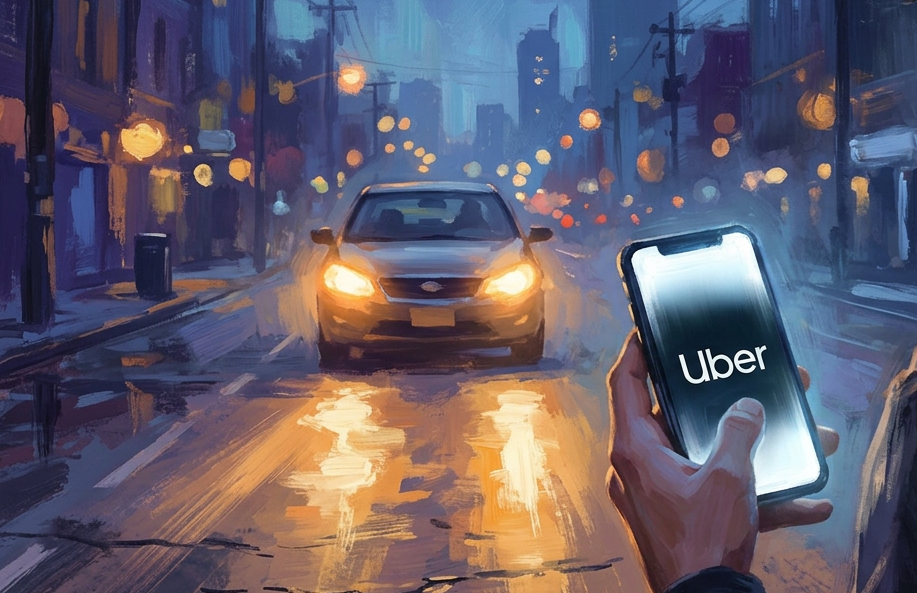
Image generated by Perplexity AI Pro
It’s 12am.
You’re leaving a bar in the city.
Home is an hour away by public transport.
You’re tired, a bit drunk, and just want to get home fast.
What’s the first thing that pops into your head?
“I’ll get an Uber”
Or
“I’ll call a taxi”
For most people, it’s the first one. Uber has become the “Google” of urban private transportation: the default verb for “getting a ride,” just like we “Google” instead of “search online”.
But sometimes we forget that this service we so easily take for granted today was once a scrappy startup.
How did that happen?
How a Frustration Became a Product
In 2008, Garrett Camp and Travis Kalanick were in Paris for a tech conference and couldn’t get a taxi. Out of that frustration came a simple question:
What if you could tap your phone and get a car to you instantly?
To answer that, they didn’t start with a massive rollout of a perfect product they spent years building. They built a very simple app, tested it with a small group of friends in San Francisco, and connected just a handful of black-car drivers to see if people would actually use (and pay for) the service in real life.
In 2010, UberCab moved into beta in San Francisco. In 2011, the service officially launched, rebranded as Uber, and began expanding to new cities like New York and Chicago.
Fun fact: not long after launching they received their first cease‑and‑desist letter. A pretty strong signal they were moving in the right direction, if you ask me!
From there, it slowly spread city by city, country by country, turning into a global platform that redefined how people thought about getting from A to B.
Did Uber Kill Taxis?
No. Taxis still exist in most cities.
But Uber did something arguably more powerful: it rewired our associations.
In many markets, “taxi” is now subconsciously linked with things like:
- More expensive (or at least feeling that way compared to app pricing).
- Harder to find, especially at peak times or bad weather.
- Unpredictable pricing and availability.
- Overall, a premium service (not for everyone).
Meanwhile, Uber positioned itself as:
- Always available (or at least findable) within minutes.
- Simple, cashless, and trackable.
- Upfront pricing you can see before you commit.
- Affordable for most people.
It didn’t remove the old option, but it made the old option feel like a worse decision.
That’s what category-defining disruptors do.
What Legacy Businesses can Learn From This
This isn’t really a story about taxis.
It’s a story about any business that assumes they’re safe because:
- “We’ve always done it this way”
- “Customers will always need us”
- “The way our industry works is just… how it is”
Because all it takes is one focused disruptor who understands:
- The real customer frustrations your industry just tolerates.
- How to use technology, UX, and pricing to remove friction.
- How to become the easy, obvious choice… while you’re still doing things the “normal” way.
They don’t have to destroy you outright, all they have to do is make you look like the taxi: more expensive, harder work, less predictable, less modern.
So, What Do You Do About It?
If you’re a business owner, the question isn’t “How do we become the next Uber?”
It’s:
- Where are we still acting like a taxi company?
- What are our customers putting up with that they shouldn’t have to?
- If someone who really understood our industry wanted to flip it on its head, where would they start?
Uncomfortable? Yes. But that’s where the opportunities are.
How I Help
I partner with founders and leadership teams to do exactly this kind of work:
- Identify the “taxi-like” parts of your business that are ripe for disruption.
- Turn real customer pain points into new, testable value propositions.
- Design and validate new products, services, or experiences before you over-invest in them.
In other words: I guide you to innovate from the inside, before someone else “Ubers” your market from the outside.
If you’re curious where your business might be vulnerable (or where the biggest upside is), I’m happy to run a short diagnostic session and share what I see.
Contact me (or just go ahead and book a 30 min call), and let’s explore whether you’re closer to “Uber” or “taxi” in your industry.
Leave a Reply